Events of ADRI Patna
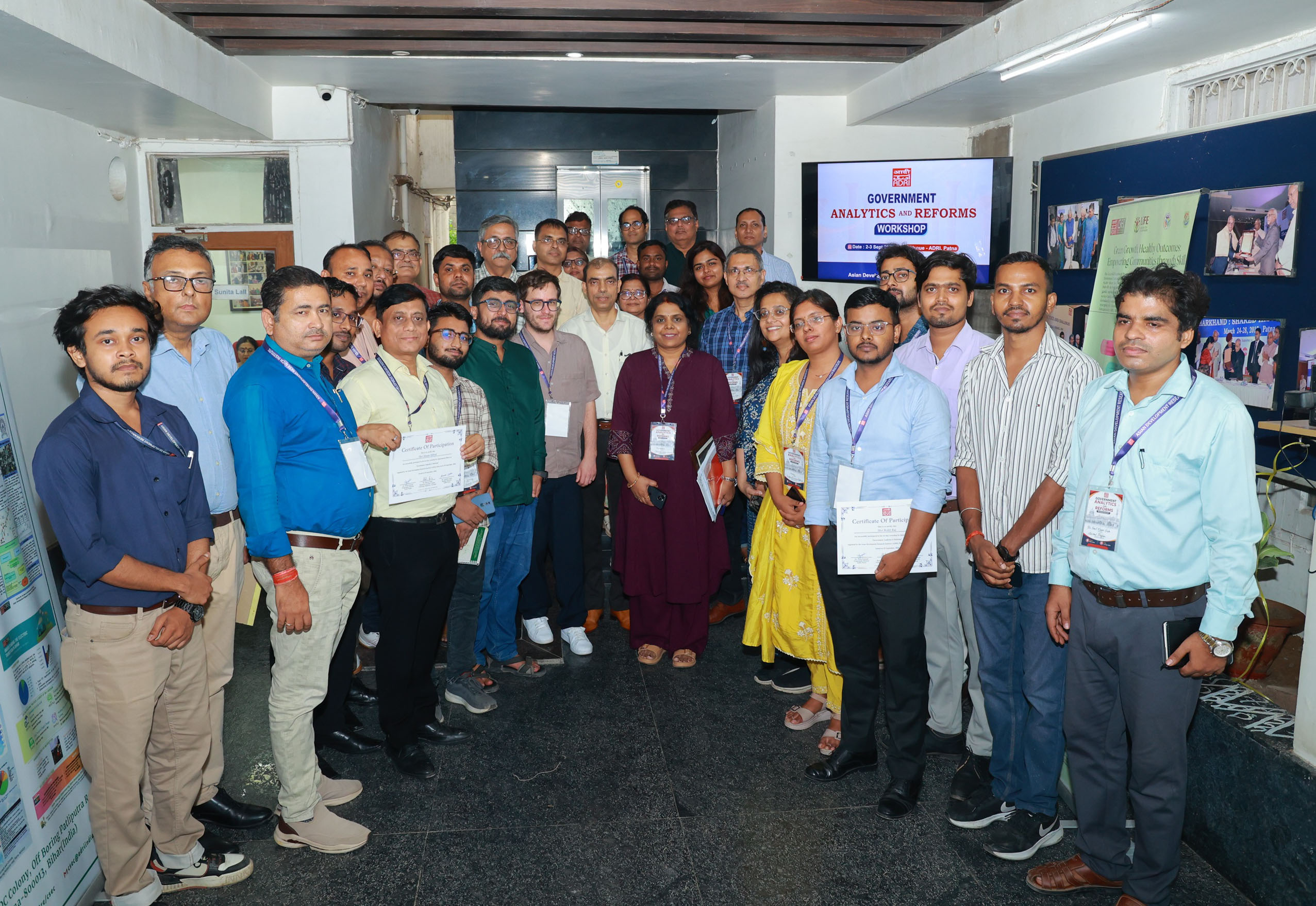
Patna, September 3. “Officers must be patient listeners, because it is only by listening carefully to the pressing issues in management practices to deliver public services that the right solutions can be identified,” said Shri Arvind Kumar Chaudhary, IAS, Additional Chief Secretary, Cabinet Secretariat Department, Government of Bihar, and Director General, BIPARD, addressing departmental teams at the valedictory session of a two-day workshop on Government Analytics that concluded here today.
The workshop titled Government Analytics and Reforms, and organised by the Asian Development Research Institute (ADRI), brought together officials from several state government departments to examine how administrative and survey data already being collected by the government can be repurposed to improve the way departments function and deliver services to citizens.
Earlier in the day, Member-Secretary of ADRI, Dr. Ashmita Gupta, recapped the highlights of the first day's proceedings, with particular emphasis on the concept of the production function. Citing the Government of Bihar's own record, she commended the state for its achievements in the electrification and road construction sectors, noting that the gains made in these areas were clearly documented in terms of both output and outcomes. This was followed by a quiz in which departmental teams tested their understanding of various elements of the production function — input, management practices, frontline behaviour, output and outcome. Dr Niraj Prakash, Programme Director, ADRI, reviewed the quiz attempted by the participants and announced the winners, who were felicitated at the end of the session.
This was followed by a lecture on the Problem Driven Iterative Adaptation (PDIA) approach by Dr. Martin Haus, co-author of the ADRI-LSE study and one of the workshop's instructors, who asserted the importance of identifying problems and breaking them down into their constituent parts to arrive at the root cause to be addressed. He further outlined the approach to planning an intervention — identifying the right authority, examining its ability, and ensuring acceptance for the proposed course of action.
Drawing on this framework, departmental teams then worked through the rest of the day on identifying specific problems confronting their own departments. Each departmental team subsequently presented its problem statement and proposed the way forward before the Additional Chief Secretary.
Among the issues presented, the Finance Department flagged the difficulty faced by its field officers in preparing utilisation certificates for funds released under various government schemes, attributing the delays to inadequate training and a fear of punitive action in the event of adverse outcomes. Officials from the Education Department highlighted the issue of lack of enrolment in Bihar Board of Open Schooling and Examination (BBOSE) for want of awareness about the scheme. Responding to the presentations, Shri Chaudhary reiterated that a patient, empathetic hearing of such field-level concerns was central to resolving them within a short span of time.